Hutchinson Island’s Beaches: Florida’s Ancient Coastline Hiding in Plain Sight
Among Hutchinson Island’s familiar ribbons of sand, craggy shelves of shell-studded rock reveal a much older Florida. Meet the Anastasia Formation, an ancient layer of coquina that preserves clues to prehistoric beaches, shifting seas, and a coastline still being carved by the Atlantic.
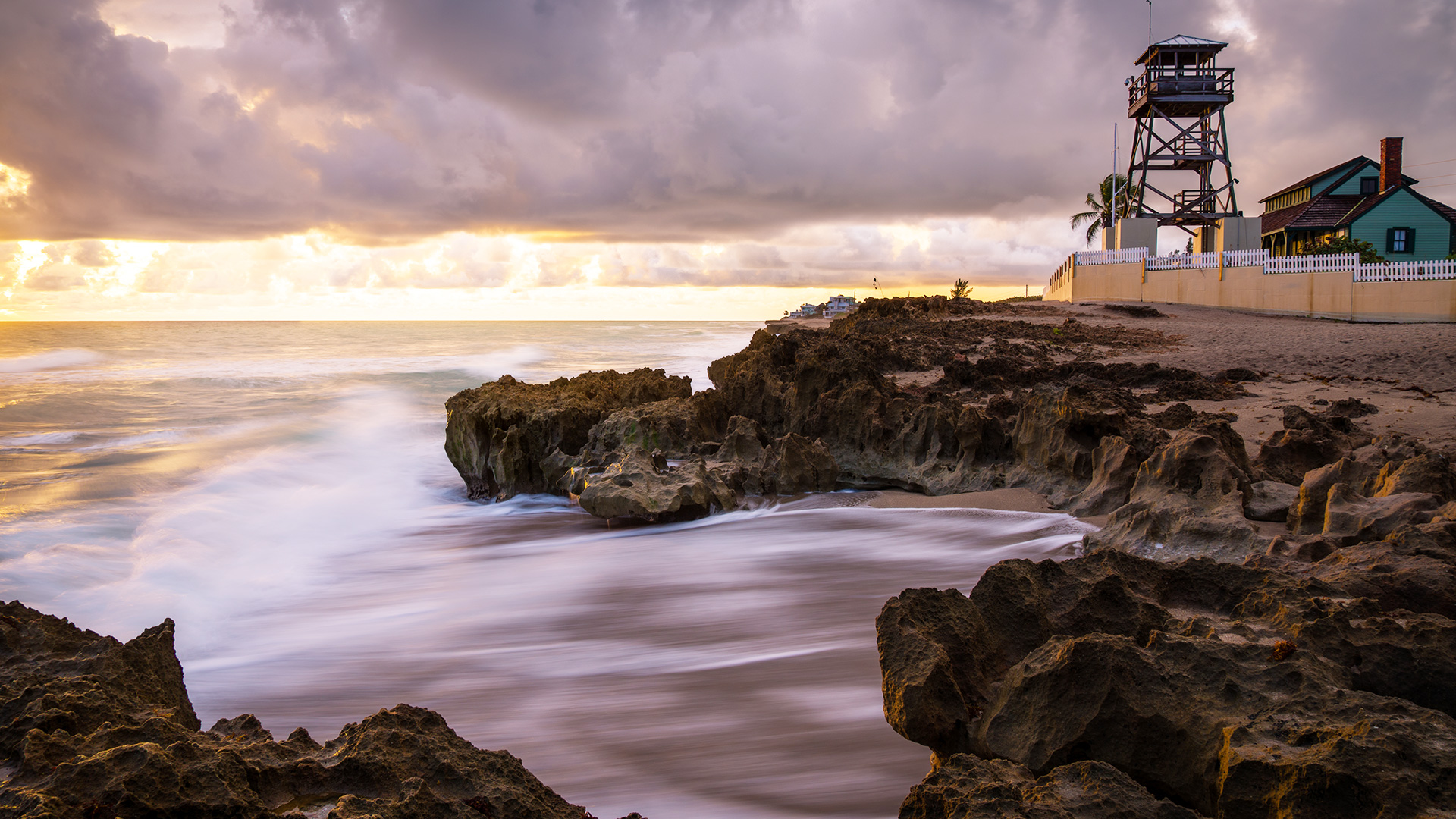
Stand on the shoreline near The House of Refuge on southern Hutchinson Island and Florida’s usual beach vocabulary suddenly stops working. Instead of an uninterrupted sweep of soft sand, slabs of rough, rusty-brown rock push through the surf. Broken shells appear frozen inside. Waves spill through holes and retreat across pocked ledges that look considerably older and wilder than the beach surrounding them.
For guests of Opal’s duo of Hutchinson Island beach resorts, Hutchinson Shores Resort & Spa and The Lucie, this strange shoreline is part of what makes the island so rewarding to explore. Follow the coast south, and you’ll encounter outcroppings of the Anastasia Formation, a Pleistocene geologic formation found only along portions of Florida’s Atlantic coast, from St. Augustine to Palm Beach County.
Think of it as a time capsule hiding in plain sight. You don’t need a fossil dig or much geological knowledge to examine it. You just need to know what you’re looking for. And from the shells embedded in the stone to the waves still carving it today, these curious rocks reveal a Florida coastline more than 100,000 years in the making – and worthy of exploring time and time again.
WHAT ARE THOSE ROCKS ON HUTCHINSON ISLAND’S BEACHES?
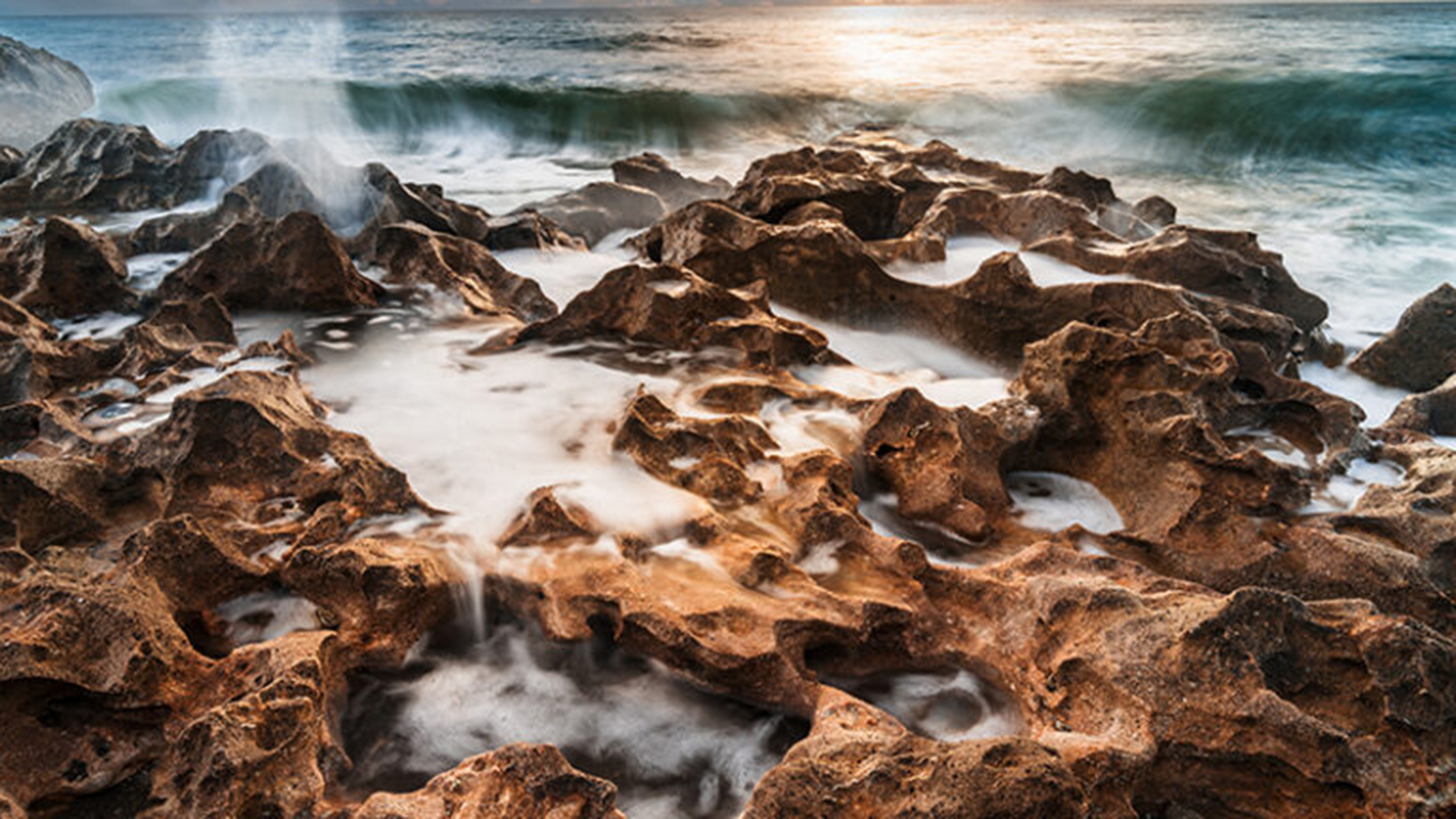
At first glance, the rocks can resemble coarse concrete. Look closer and their origins become obvious: shell fragments are packed among grains of quartz sand, bound together by calcium-carbonate cement. This shell-rich limestone is known as coquina, from the Spanish word for “small shell.” On Hutchinson Island, it belongs to the larger Anastasia Formation, a band of Pleistocene marine deposits associated with Florida’s Atlantic coast.
Meet the Anastasia Formation
Named for Anastasia Island near St. Augustine, the formation isn’t one continuous layer of identical rock. It can include coquina, sand, shell beds, sandy limestone, and calcareous sandstone. In Martin County, geologists have described it as consisting largely of sand and shells interspersed with harder, cemented layers.
The formation dates to the Pleistocene era, when repeated glacial and interglacial periods caused sea levels to rise and fall. For low-lying Florida, those fluctuations dramatically shifted the coastline. Places that are dry land today could have been beaches, dunes, offshore bars, bays, or shallow marine environments.
The rocks beside today’s Atlantic, in other words, contain pieces of an older Atlantic coast.
HOW DID THE ROCKS ON HUTCHINSON ISLAND FORM?
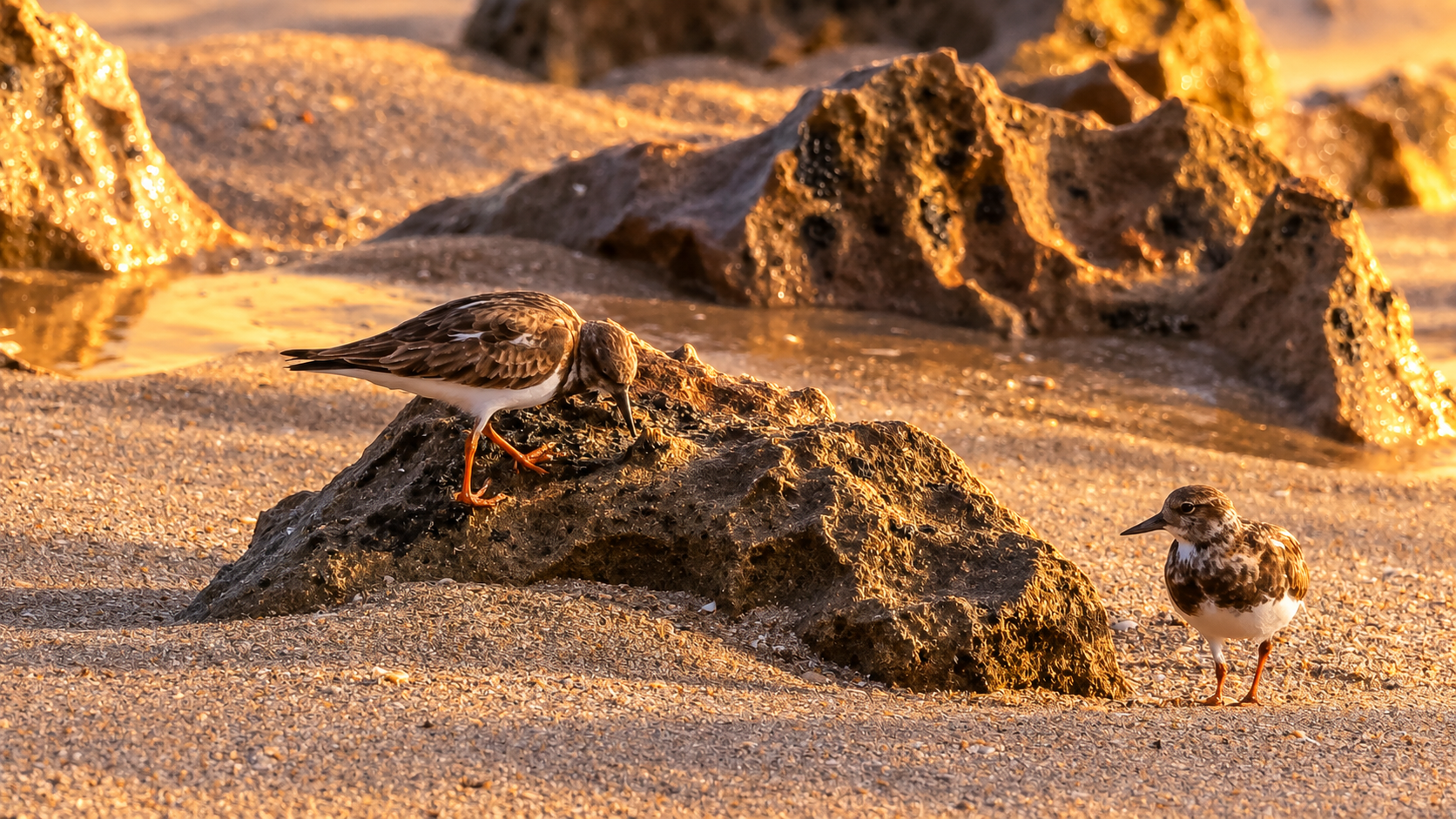
Picture a prehistoric shoreline where waves continually sorted quartz sand and broken shells. Over time, calcium-carbonate minerals formed between those loose particles, acting as a natural cement. Portions of the accumulated sediment hardened into coquina.
The process wasn’t uniform, which helps explain the formation’s appearance today. Some layers became strongly cemented and resistant; others remained much easier for water and weather to remove.
That difference is visible without a microscope. The hardest layers are the ones still standing up to the Atlantic.
WHY ARE SOME HUTCHINSON ISLAND BEACHES ROCKY?
Here’s the curious part: the Anastasia Formation isn’t limited to the conspicuous rocks you can see. Much of it lies beneath younger sand and sediment. So the real question isn’t why the rock exists here. It’s why you can see it in some places and not others. The beach is constantly rearranging itself
Sand is always moving. Waves and currents carry it along the shore and between the beach and offshore areas. Seasonal conditions alter that balance, while storms can rearrange the shoreline much more dramatically. When enough sand accumulates, the older rock underneath disappears. When erosion strips sand away, harder ledges emerge again.
That means the formation can look different from visit to visit. A shelf prominent today might be partially buried months later, while energetic surf can uncover rock that had been hidden. It’s one reason Hutchinson Island is worthy of return visits time after time: The shoreline is never quite the same, with each trip offering another chance to see a new piece of its ancient past revealed.
HOW OLD ARE THE ROCKS ON HUTCHINSON ISLAND?
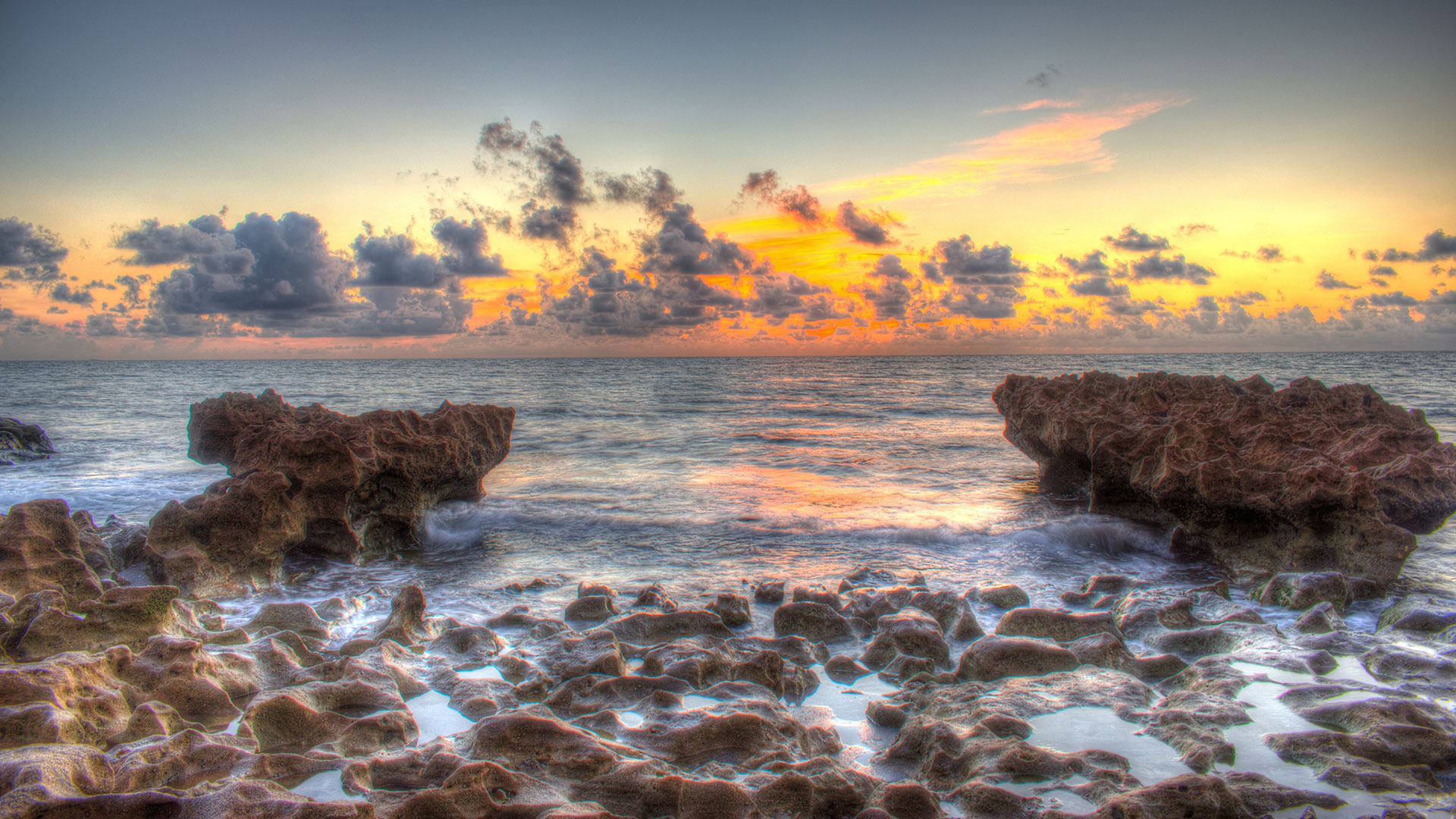
“More than 100,000 years old” is a useful shorthand. Geological mapping has cited an age of roughly 110,000 years for portions of the Anastasia Formation, which represents sediments deposited during the late Pleistocene. But every ledge shouldn’t be assigned one exact birthday. The formation accumulated in different coastal settings and at different times.
Think of it instead as a prehistoric coastal archive. Sediments accumulated, hardened, were buried and exposed, and then endured thousands upon thousands of years of erosion. What survives on the beach today is only the latest chapter.
WHAT ARE THE SHELLS STUCK INSIDE THE ROCKS?
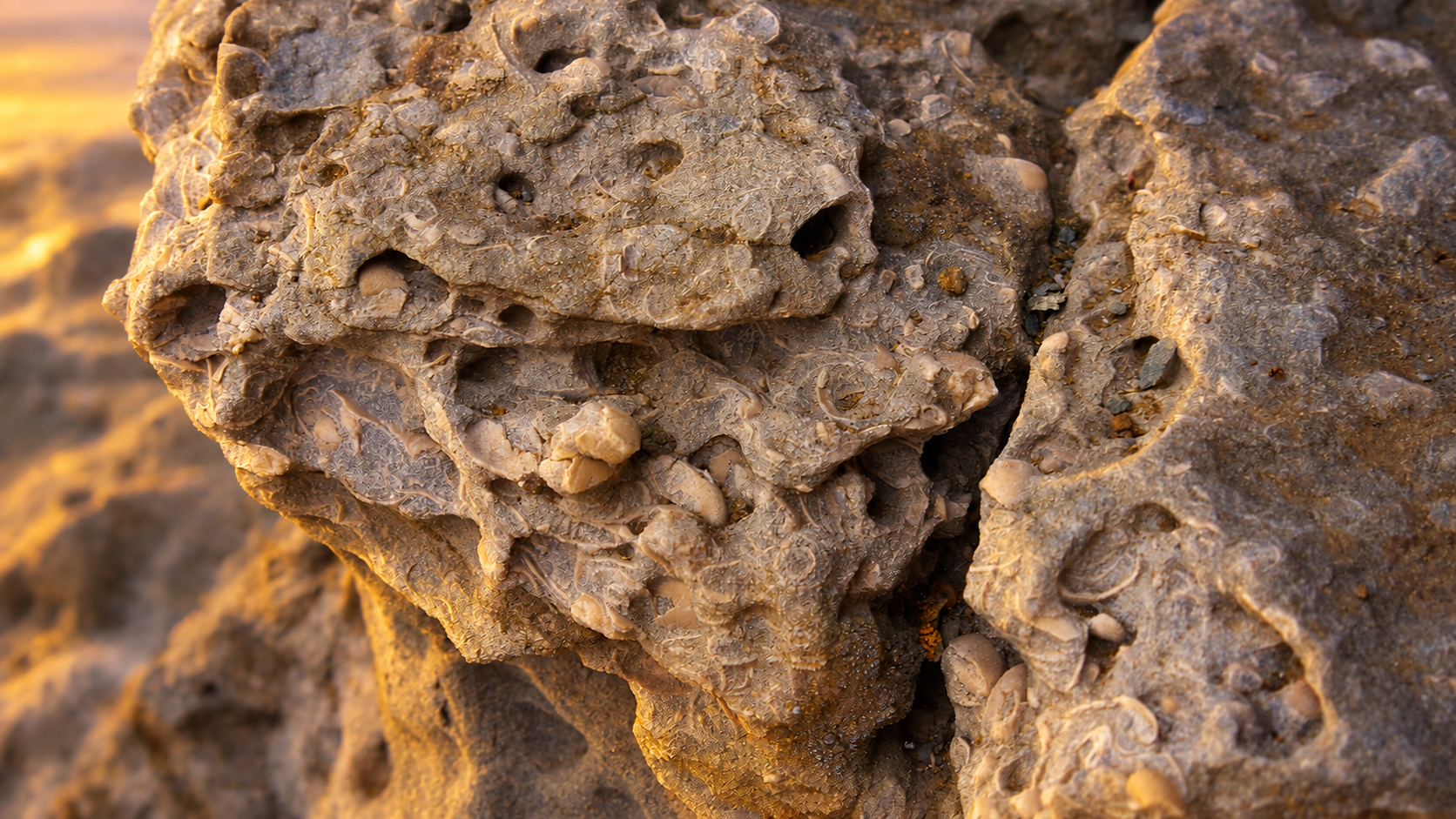
Look closely and the formation starts to read almost like a scrapbook. Mollusk shells are a major ingredient of coquina. Some remain recognizable; others were smashed and abraded by waves before becoming part of the rock. Alongside them are quartz grains and, in some samples of the Anastasia Formation, traces of organisms including coral, coralline algae, echinoids, foraminifera, and Halimeda (a type of calcified algea).
They aren’t simply decorative flecks. They’re clues.
Shells Reveal What This Coast Used to Be Like
The condition of those shells helps geologists interpret the environment in which they accumulated. Broken, battered fragments are consistent with energetic water that repeatedly churned and transported material. More intact shells in finer sediment can indicate quieter conditions.
There are even traces of animals that left no shells behind. Exposures in Martin and Palm Beach counties contain trace fossils – preserved evidence of animal activity, such as burrows through ancient sediment. Tubular structures have been documented at The House of Refuge.
To the casual observer, one might look like another hole in a very holey rock. To a geologist, it can preserve something an animal did on this coastline more than 100,000 years ago.
WHY DO HUTCHINSON ISLAND’S ROCKS LOOK SO CRAGGY?
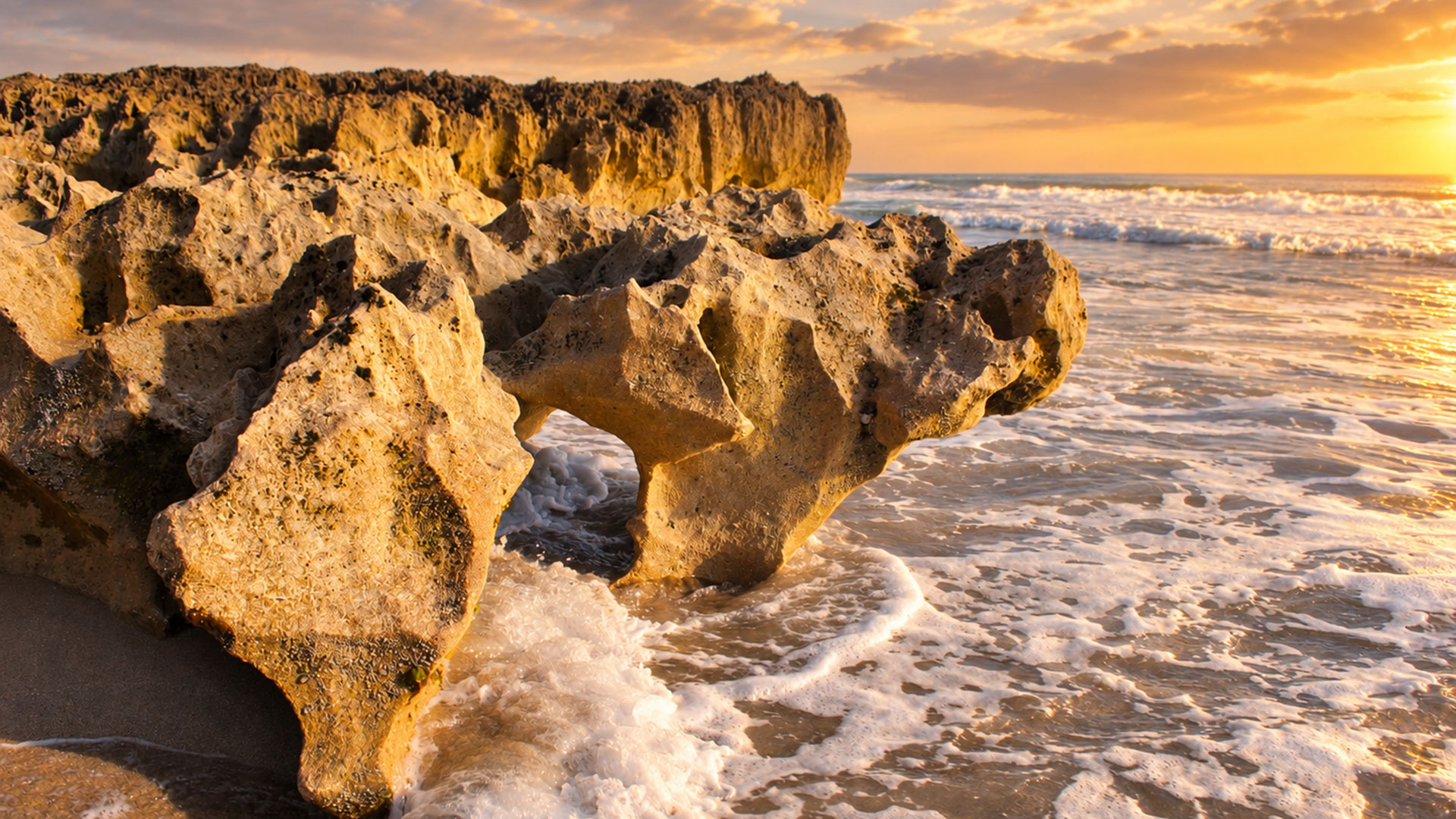
The Anastasia Formation may be ancient. Its present shape isn’t.
Incoming waves exploit cracks and depressions. Loose grains wash away. Softer material retreats while harder portions remain. Over time, a relatively solid slab becomes a miniature landscape of channels, pockets, ledges, holes, and jagged ridges.
The Atlantic is Still Carving Them
That ongoing erosion is also what makes the rocks such compelling photographic subjects. Tide, surf, sand, weather, and light continually change the composition. A depression can become a reflecting pool between waves. Sunrise can throw the rock’s rough texture into relief. A long exposure can turn moving surf into soft ribbons around stone formed more than a hundred millennia ago. There is no single definitive view. The rock supplies the ancient subject; the Atlantic keeps rearranging the frame.
WHERE CAN YOU SEE THE ROCKS ON HUTCHINSON ISLAND?
Exposures can appear at different points along the island depending partly on sand and shoreline conditions. But southern Hutchinson Island offers one of the clearest combinations of geology, scenery, and local history.
The House of Refuge
Set along one of southern Hutchinson Island’s most dramatic stretches of exposed coquina, The House of Refuge at Gilbert’s Bar pairs the island’s ancient geology with its maritime history. Built in 1876 to aid shipwreck survivors, it is the last surviving one of Florida’s original Houses of Refuge and the oldest standing structure in Martin County. Below it, craggy shelves of the Anastasia Formation meet the Atlantic, making this one of the most compelling places to see Hutchinson Island’s prehistoric coastline in plain sight.
And What About Bathtub Beach?
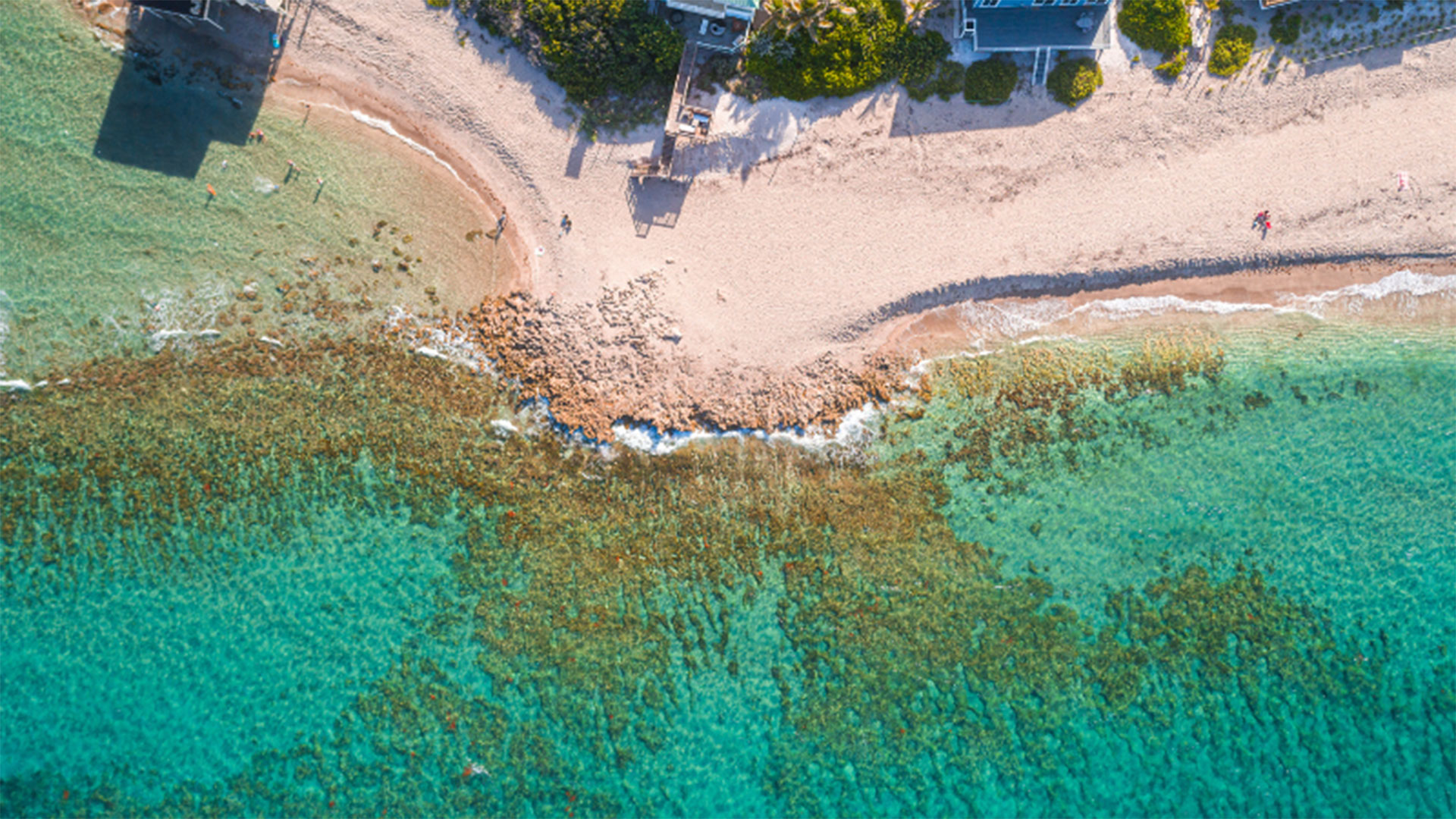
Nearby Bathtub Beach adds another geological twist to this stretch of Hutchinson Island. Its shallow reef – actually built by colonies of tiny sabellariid worms that cement sand and shell into tubes – helps break incoming waves and create the calmer water behind the beach’s name. While easily mistaken for the Anastasia Formation, the reef is actually a separate, living structure – meaning within a short stretch of shoreline, you can see both ancient Pleistocene rock and a modern reef still being built today.
A SHORELINE WORTH LOOKING AT TWICE, AND VISITING TIME AND TIME AGAIN
Hutchinson Island’s geology rewards the second glance. At first, you see the familiar Treasure Coast palette: Atlantic blue, pale sand, sea oats. Then you notice the rock, and the shoreline gains another dimension. These shell fragments aren’t simply beach debris. The ledges aren’t random obstacles in the surf. They’re remnants of prehistoric coastal environments, hardened into stone and exposed again as the modern Atlantic rearranges the sand above them.
For travelers accustomed to thinking of Florida beaches as landscapes made almost entirely of sand, that’s the surprise of Hutchinson Island: Some of the coast’s deepest history isn’t buried in a museum.
It’s breaking through the beach