Meet Maine’s Wildest Winter Ride: The Camden Toboggan Chute
Every February, costumed competitors descend on a small Maine ski area to race down a 400-foot wooden chute onto a frozen pond. Here’s the story behind the U.S. National Toboggan Championships – and how you can get in on the fun yourself during select dates this winter.
There’s no telling what you’ll see at the starting line of the U.S. National Toboggan Championships. A team dressed as bananas? A group of first-timers preparing for their maiden voyage? Seasoned competitors hoping to shave a few seconds off their previous run? All are fair game at this wonderfully unconventional winter competition in Camden, Maine.
The premise is simple, if a little outrageous: Climb aboard a traditional wooden toboggan, launch yourself down a 400-foot-long ice-coated chute at speeds approaching 40 miles per hour, and hold on as you shoot out onto the frozen surface of Hosmer Pond.
Welcome to the Camden toboggan chute, one of Maine’s most unusual winter attractions and the centerpiece of the annual U.S. National Toboggan Championships, returning February 5–7, 2027, for its 36th year. And while the high-speed descents are certainly entertaining, the festivities surrounding them are half the fun.
PART COMPETITION, PART COSTUME PARTY, ALL MAINE
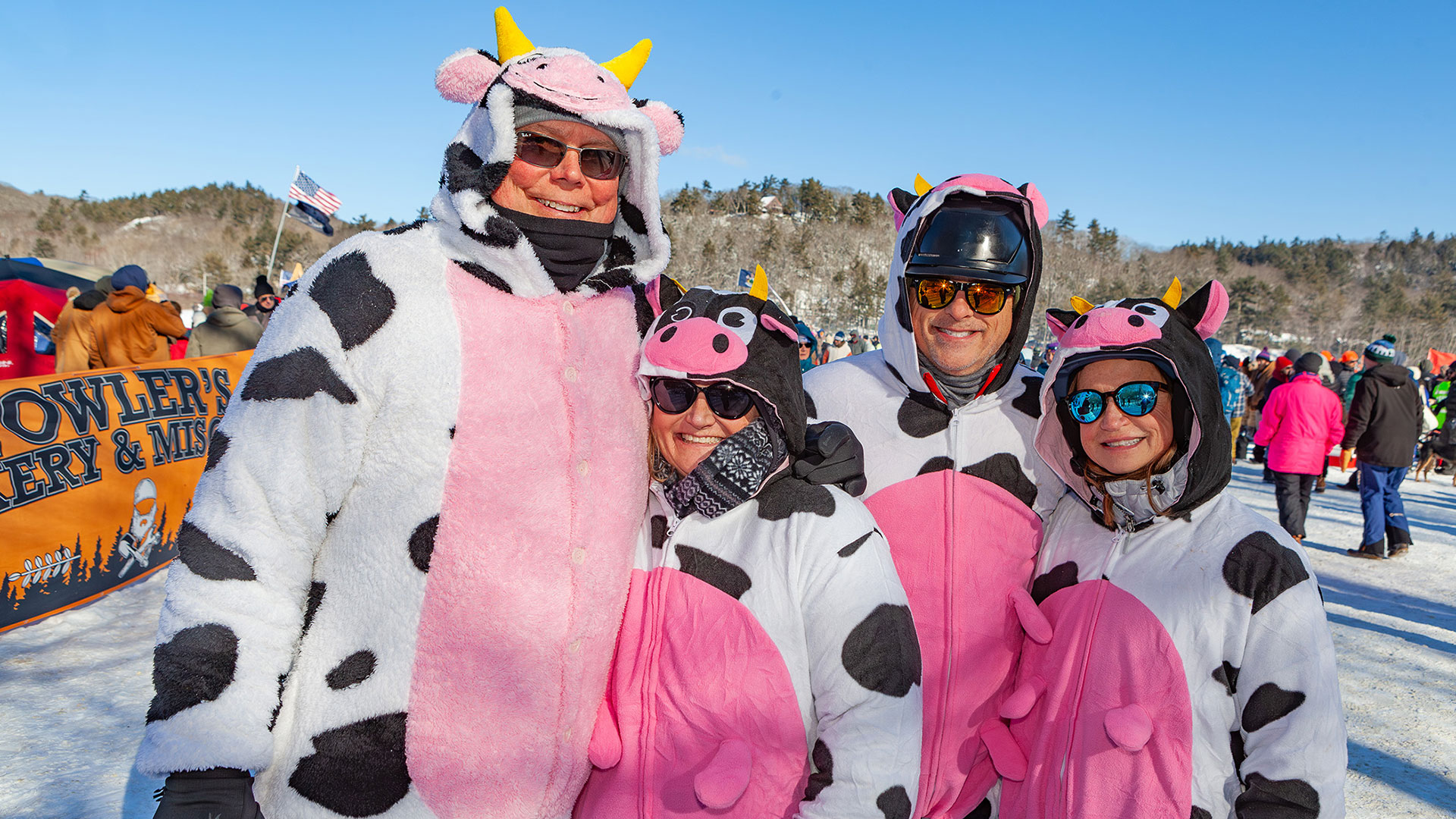
If the name U.S. National Toboggan Championships conjures images of elite athletes in aerodynamic racing suits, Camden has a few surprises in store.
For starters, there’s the dress code – or rather, the complete lack of one. Past competitors have taken to the chute dressed as everything from penguins and superheroes to moose and Little Red Riding Hood. One particularly inventive team even paid tribute to Tom Petty and the Heartbreakers under the name “Tom Sleddy and the Heartbreakers.” And with team names like the Big Kahoonas, Throbbin’ Boggins, and Chuting Stars, it’s clear that a sense of humor is practically a prerequisite.
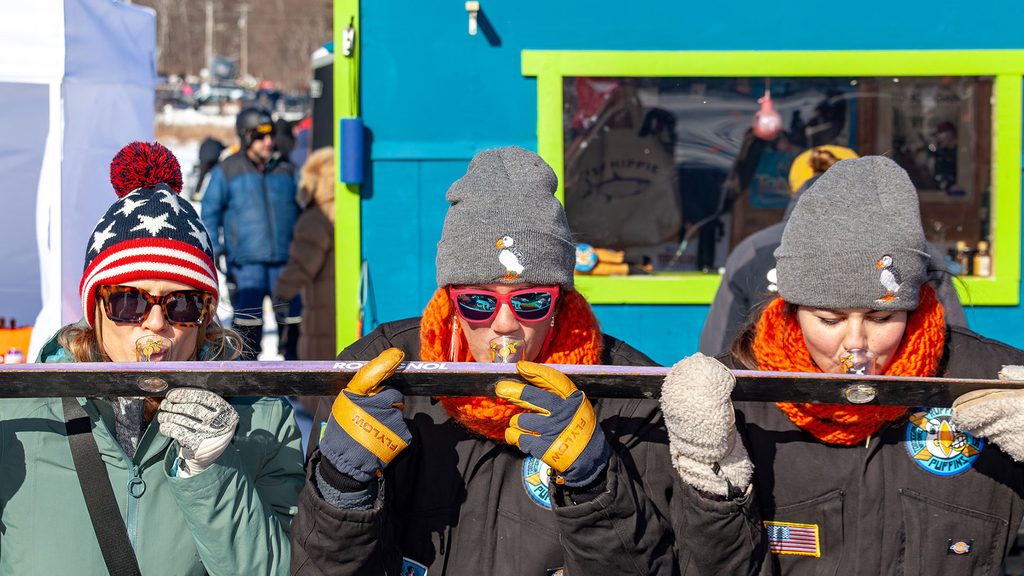
The festivities extend well beyond the starting line. Each February, the area around the chute and frozen Hosmer Pond transforms into Tobogganville, a lively winter gathering complete with tents, ice shacks, tailgating parties, food, music, and a costume parade. In 2026, more than 5,000 visitors descended on Camden Snow Bowl to watch 413 teams compete.
But don’t let the silliness fool you. Beneath all those costumes are some seriously competitive racers, many of whom return year after year with carefully crafted sleds and their sights set on the fastest time.
It’s that unlikely combination of fierce competition and good-natured fun that gives the championships their character. And behind the spectacle is a nearly 90-year-old tradition built on ingenuity, community spirit, and a distinctly Maine approach to winter recreation.
THE COMMUNITY-BUILT HISTORY BEHIND THE CHUTE
1936: A Winter Traditional Takes Shape
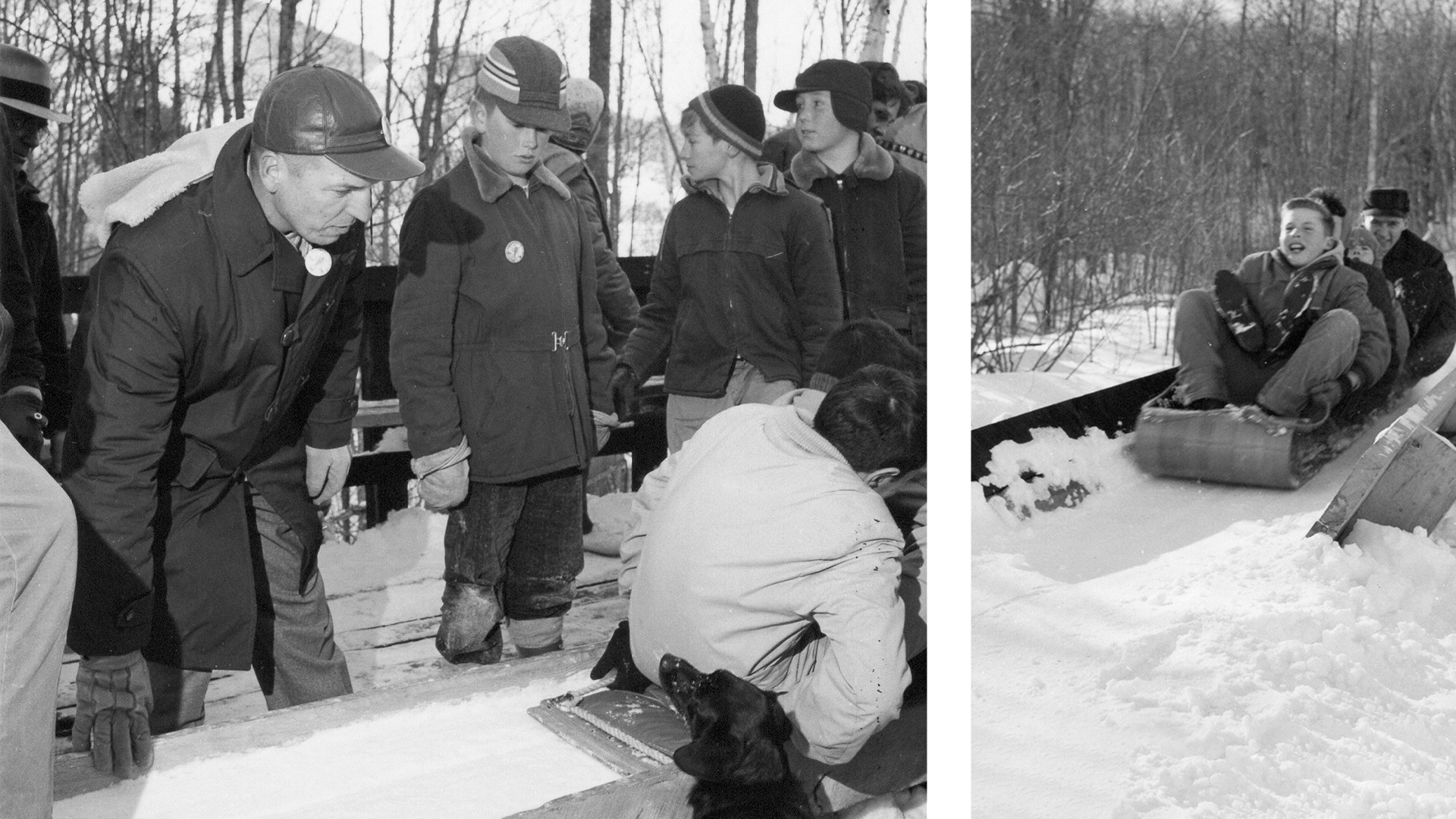
In 1936, a group of enterprising Camden residents set out to build a toboggan chute at what would become Camden Snow Bowl. The only problem? There was no road to the site, meaning construction materials had to be transported across Hosmer Pond.
Their solution? Float them over. According to the championships’ official history, volunteers used small boats and rafts fashioned from donated telephone poles to haul supplies across the water. The resulting winter playground soon became a community gathering place, hosting carnivals complete with hockey, wood-chopping competitions, horse races, and dancing on the ice.
The chute underwent several transformations over the decades. Coast Guardsmen rebuilt it in 1954, but deterioration forced its closure in 1964. It wasn’t until 1990 that local resident Jack Williams rallied volunteers to restore the structure, paving the way for the first U.S. National Toboggan Championships in 1991. Today, the historic chute bears his name.
The Secret Ingredient? A Lobster Tote
Keeping the chute operational has required some ingenuity of its own. Take the icing system devised by hotelier David Dickey, which used a water-filled lobster tote, ropes, and pulleys to slowly coat the wooden run in layers of ice during the coldest nighttime hours. It’s an inventive bit of engineering that seems especially fitting for a Maine winter tradition.
And that same resourceful, community-minded spirit continues to define the championships today.
The Volunteers Keeping the Tradition Alive
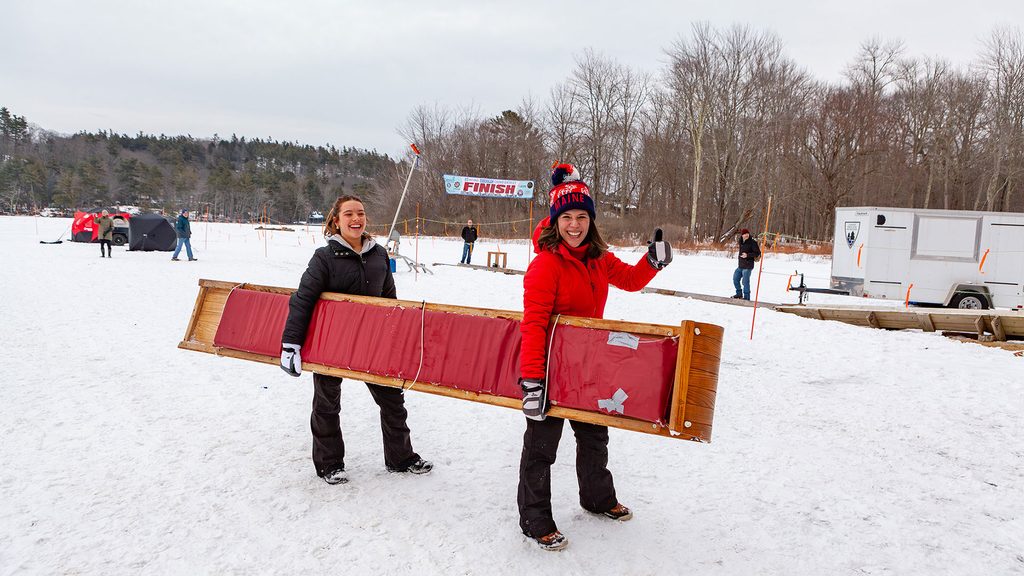
That same resourceful, community-minded spirit continues to define the championships today.
Holly S. Anderson, the event’s co-chair and communication and outreach coordinator, points to the volunteers and local organizations that help make the event possible. The championships are a major fundraiser for the municipally owned Camden Snow Bowl, but other community groups benefit, too. “Local Rotarians spend both days parking racer and spectator vehicles and in exchange, we split the proceeds of parking income,” Anderson explains.
She also recalls a youth Habitat for Humanity group that once sold shuttle-bus tickets in exchange for a portion of the proceeds. The shuttle has since become free to encourage ridership.
Nearly nine decades after those first volunteers floated building materials across Hosmer Pond, the championships remain a community undertaking. The costumes and high-speed descents may attract the crowds, but it’s the people behind the scenes who keep this winter tradition alive.
YOU DON’T HAVE TO BE A PRO TO RACE
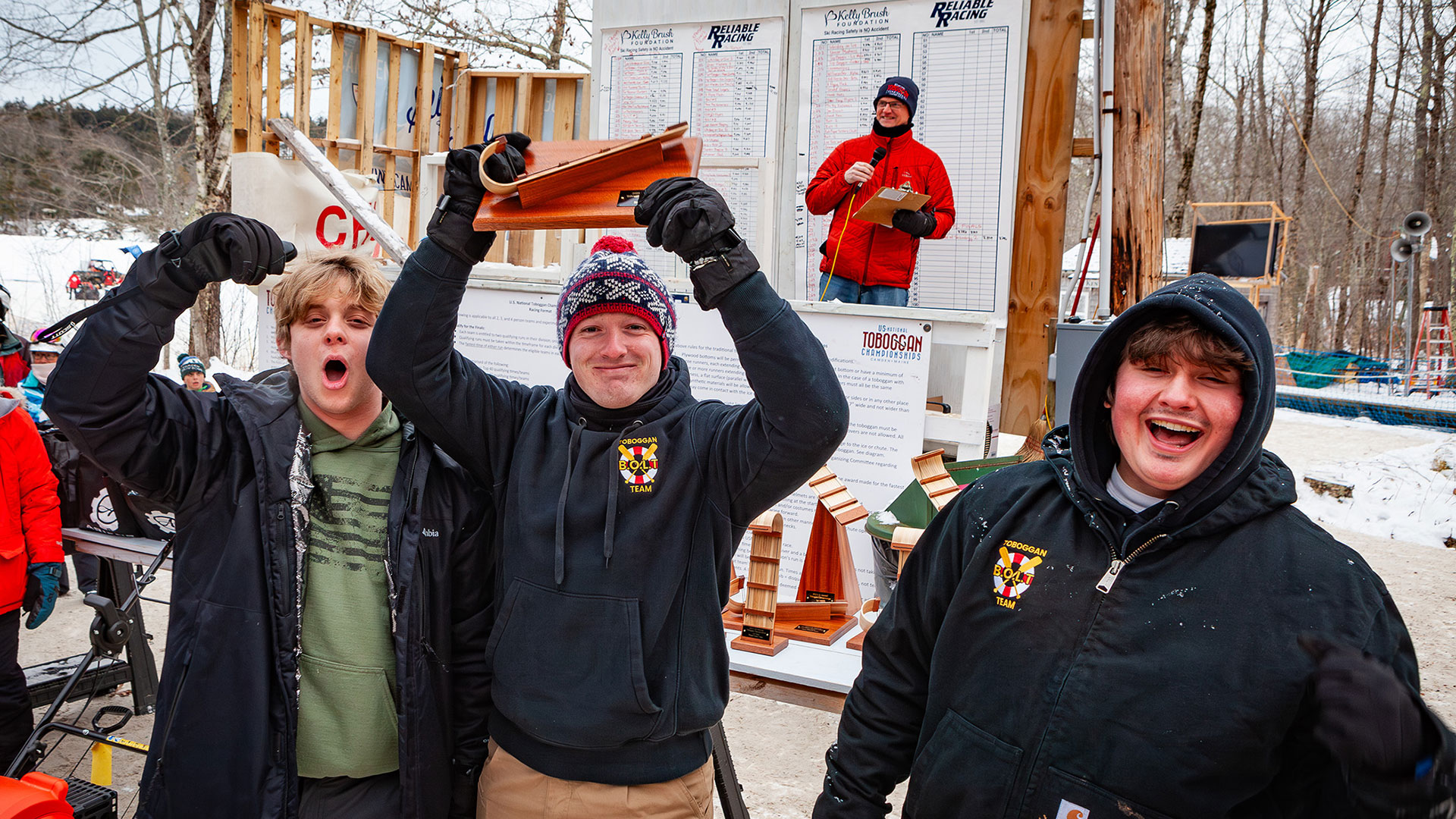
For an event with “National Championships” in its name, the competition is surprisingly welcoming to amateurs. In fact, you don’t have to be a professional athlete, an experienced tobogganer, or even the proud owner of a wooden sled to take part.
That’s one of Anderson’s favorite things about the event: the opportunity for newcomers to compete alongside seasoned racers, with very little standing between an enthusiastic spectator and a spot at the starting line.
The Snow Bowl even maintains a shared supply of toboggans that registered teams can borrow. Simply take your run, return the sled, and let the next group have its turn.
Of course, that doesn’t mean anything goes.
There are official competition rules governing everything from toboggan construction to safety requirements. Sleds must be made of traditional wood with visible grain, for example, and cannot exceed 50 pounds, including their padding. Even costumes have to meet safety standards, with loose accessories and trailing pieces properly secured. And while speed is certainly part of the appeal, craftsmanship earns recognition, too.
Still, the biggest challenge for first-timers might simply be working up the nerve to take that initial plunge. After all, there’s a considerable difference between watching a toboggan roar down the chute and finding yourself perched at the top, preparing to do the same.
Anderson describes the event as “infectious,” adding, “If you attend as a spectator you’re more than likely coming back as a racer!”
Consider yourself warned.
HOW TO EXPERIENCE THE CAMDEN TOBOGGAN CHUTE
The U.S. National Toboggan Championships may be the chute’s biggest moment of the year, but you don’t necessarily have to enter the competition to experience this historic winter attraction yourself.
Camden Snow Bowl also offers public tobogganing on select winter weekends when conditions permit, giving visitors an opportunity to take the plunge outside championship competition. Here’s what to know before planning your visit.
Come for the Championships – or Take Your Own Turn
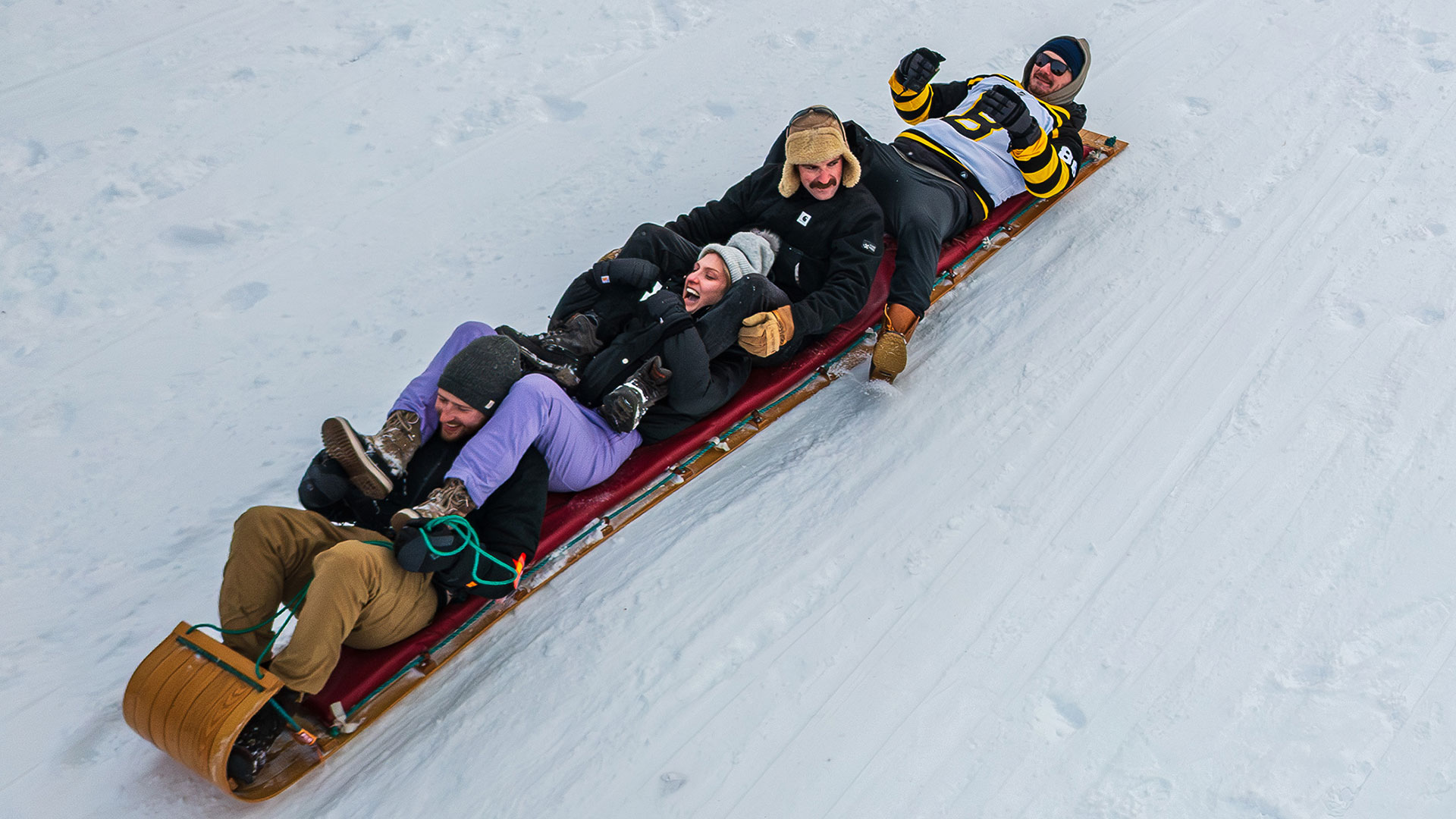
If the colorful costumes, competitive racing, and Tobogganville festivities are what you’re after, mark your calendar for February 5–7, 2027, when the 36th annual U.S. National Toboggan Championships are scheduled to take place.
Interested in racing? Check the official championship website for registration information, rules, and the latest event schedule.
If you’d rather experience the chute during a separate public tobogganing session, sleds are provided, so there’s no need to pack your own equipment.
Just remember that championship weekend and public riding sessions are two different experiences. Don’t assume you’ll be able to show up and take a recreational run while the races are underway.
Check the Ice Conditions Before You Go
Here’s an important distinction: Snow on the ski slopes doesn’t necessarily mean the toboggan chute is ready for riders. Unlike skiing, tobogganing at Camden Snow Bowl requires suitable ice conditions both inside the wooden chute and across Hosmer Pond, where sleds complete their journey. That means public riding days are weather-dependent, and operating schedules can change.
Before heading out, consult the Snow Bowl’s current conditions report for chute-specific updates. It’s also worth building a little flexibility into your winter itinerary, particularly if taking a ride is one of your main reasons for visiting.
For additional information on public sessions, visit the Camden Snow Bowl tobogganing page.
Dress for the Ride, Not the Runway
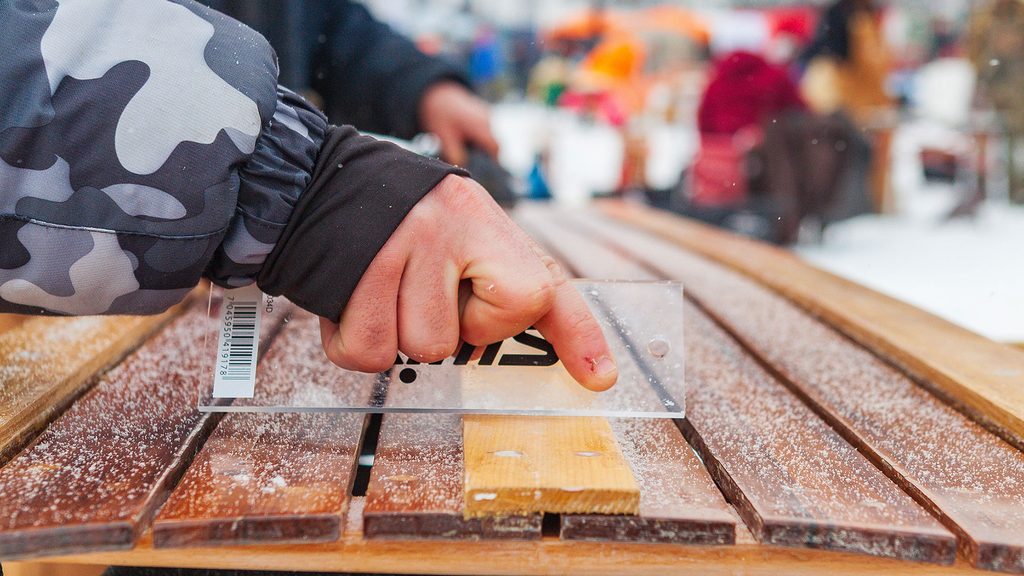
While the championships may inspire some elaborate outfits, practical clothing is the better choice for a recreational run. Camden Snow Bowl recommends wearing older, less bulky outerwear, since contact with the chute’s wooden sides can scuff clothing. Gloves or mittens are required, while helmets and face coverings are strongly recommended.
Planning to bring the kids? Published public-riding guidelines specify a minimum age of five, require children under 12 to ride with an adult, and allow up to four riders per sled. Confirm current requirements before visiting.
MAKE A WINTER WEEKEND OF IT AT SAMOSET RESORT

Of course, there’s no reason your Midcoast Maine winter adventure has to end once the toboggan comes to a stop. Just down the coast in Rockport, Samoset Resort makes a comfortable home base for exploring the area’s winter attractions, with Camden Snow Bowl within easy reach.
Spend the day cheering on costumed competitors or taking your own turn down the historic chute, then retreat to the resort to warm up. A dip in the year-round indoor pool offers a decidedly more relaxing way to enjoy the water, while Opal Spa provides an opportunity to unwind after a day in the cold.
And with winter conditions occasionally calling the shots, it’s worth keeping your plans flexible. If the chute isn’t operating, the surrounding area still offers opportunities to enjoy the season, from skiing at Camden Snow Bowl when conditions allow to simply settling into a slower-paced coastal Maine getaway.
Who knows? By the end of the weekend, you might already be plotting your return for next year’s championships – complete with a racing team, borrowed toboggan, and a costume worthy of the starting line.